A Note on Gu Hao’s Theory of Archery (She Shuo 射说) – The Inner and Outer Efforts (内功 / 外功)
There is no doubt that the most widely read Chinese archery manual in the English World is Justin Ma’s translation of Gao Ying’s (高颖)archery commentary. The objective of writing this short essay is for the purpose of giving English speaking archers a glimpse of what Gu Hao (顾镐), a Qing archer, had offered to the world and diversifying what the West may think of Chinese Archery. Here, Chinese Archery refers specifically to the style practiced during the Qing Era (大清)using the Manchu bow (清弓) standardized during that time. Whether there are direct connections to Ming’s style of archery (e.g. Gao Ying’s) in terms of philosophy and approach, I will leave it for the readers to decide. Gu’s text however did influence the later Manchu-Han bilingual text, Theory of Shooting the Target (Gabtan‑i‑Jorin / Shedi Shuo 射的说), authored by Manchu bannerman Canging. Keep in mind, for his contemporaries there was only “archery” without distinguishing between Qing, Ming, Tang, Song, Chinese, Korean, Japanese, and English, etc. Please leave your comments and let me know your thoughts.
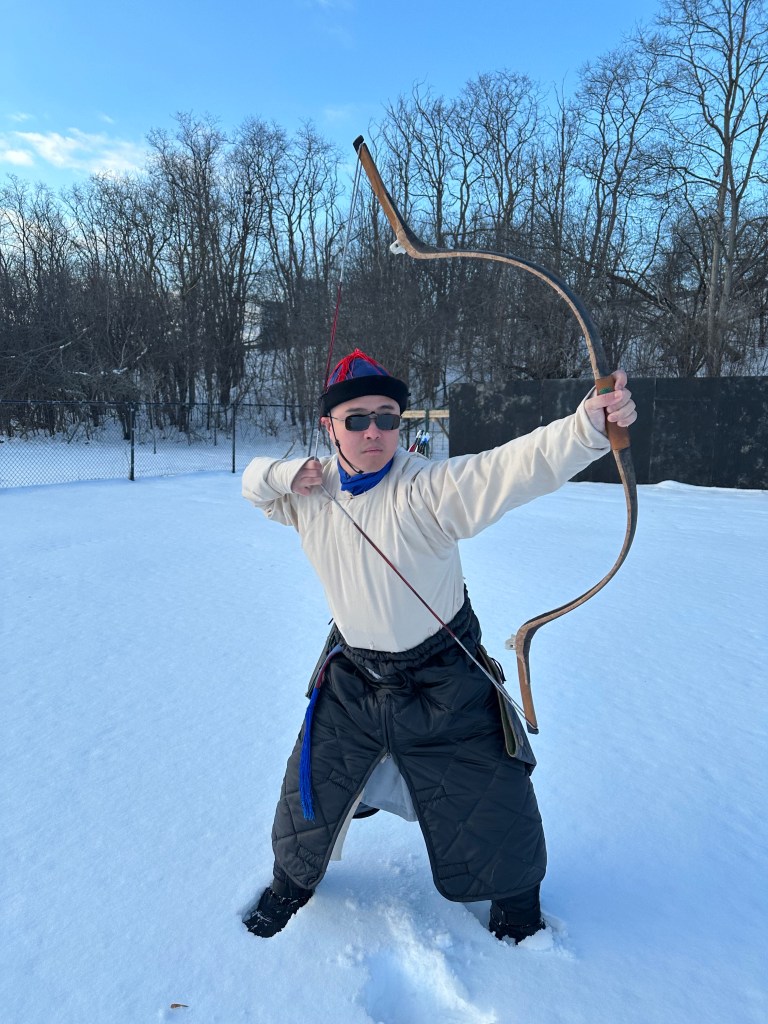
Let’s imagine he is Gu Hao…
Gong (功) is the Mandarin word for Kung as in Kung-Fu (功夫 popularized by Cantonese immigrants). Allow me to reference to the Netflix’s show Marco Polo, which the martial arts master Hundred-Eyes told Marco that Kung-Fu is “supreme skills from hard work”. I agree with his definition. Gong can be translated as efforts, drills, practice, and repetitions; which resonates with some archers shooting up to hundred arrows over hours with intense. I have chosen the first possible translation, Efforts, because the practice of archery is an active exertion of focus and physical endurance to achieve one’s goal of hitting the target consistently with perfect technique.
According to Gu, there are two kinds of Gong in archery: Nei-Gong and Wai-Gong. For those familiar with Chinese Martial Arts (especially popular movies like Crouching Tiger, Hidden Dragon), you may already know these words. Nei-Gong (内功)refers to the inner cultivation of Qi and mental state that allows movie characters to accomplish mystical feats and jumping long distances like birds. Wai-Gong (外功)refers to the tangible movements and cultivation of muscle strengths and memories. Gu believes that both are important, and Wai-Gong serves as a gateway for beginners and intermediates to enter the cultivation of Nei-Gong.
Nei-Gong (Inner Efforts)
Zheng-Xin (正心 Correct Mind): A mind free from wrong thoughts and cannot be taken by distractions.
Cheng-Yi (诚意 Sincerity) The mind remains before the target and constantly examines one’s intention and form.
Cun-Shen (存神 Sustaining the Spirit) Move and stop with calmness, eliminating agitation.
Yang-Qi (养气 Cultivating the Energy, Qi) Forget gain and loss, showing neither joy nor anger.
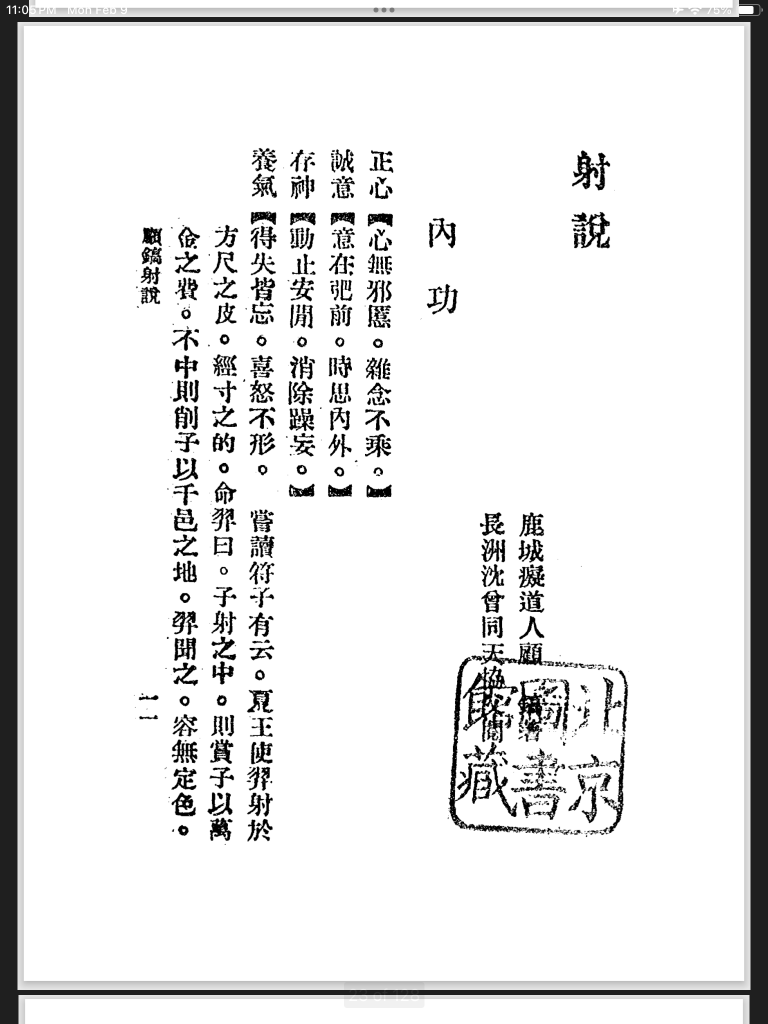
Gu emphasized on Yang-Qi by telling a story.
The King of Xia once commanded Lord Yi (a legendary Chinese archer) to shoot stating that if he hits ten thousand taels of gold would be granted but should he miss a thousand counties would be stripped from the lord’s fief. Upon hearing the command, Lord Yi had lost his composure and different Qi were fighting within his chest. He missed the target and missed it again. Although there would never be any archers as skillful as Lord Yi, he could not hit with his Qi agitated.
Gu said “When relating to people and handling tasks, we must quiet our Qi with calm spirit. Only then can one make correct decisions, and there will only be failure otherwise.”
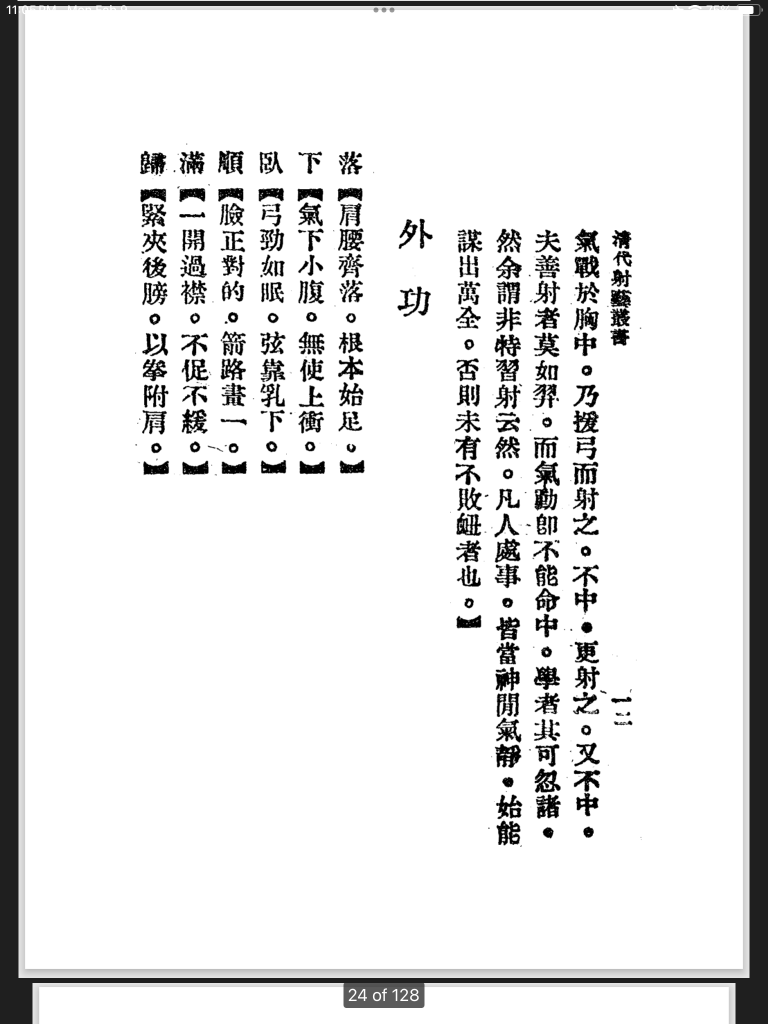
Wai-Gong (Outer Efforts)
Luo (落 To Settle): Settle the shoulders and waist together. The foundation begins with one’s feet.
Xia (下 To Sink): Sink one’s Qi to the lower abdominis. Do not let it arise.
Wo (卧 To Crouch) The force of the bow should lean. With the bowstring approaching below one’s breast.
Shun (顺 To Draw) One’s face should face head on toward the target. The path of the arrow draws the Yi (一, one) character.
Man (满 To Fulfill) The Yi draw (it refers to both the horizontal draw and one movement) passes the lapel. It is neither rushed nor delayed.
Gui (归 To Return): Tighten one’s draw arm elbow. Attach the fist to the shoulder (this refers to aligning the forearm on top of the back arm ideally on the same vertical plane).
Ping 平 (To Balance): The two fists are aligned like counterbalance. The arrow passes the lips.
Kong (空 To Empty): The rib cage is empty as if there were no obstructions.
Ding (定 To Focus): Appear as if one is in meditation. Shen-gu (to aim, but it has a much deeper meaning to be discussed separately) and to release. Ding must be treated flexibly. It is just synchronizing one’s mind and body and achieving a correct mental state. There is no need to conform to a certain time duration for those who are accomplished. However, it is beneficials to lengthen the time in the state of Ding for beginners.
Yun (匀 To Split (evenly)): The release, follow through, and stop should be evenly split (between the two arms) with the energy of tearing fabrics. It was challenging to translate the word, Yun. Gu has elaborated on the meaning of Yun in a later section on release, which is not covered in this post. The translation here has made use of Gu’s elaborations from that section.
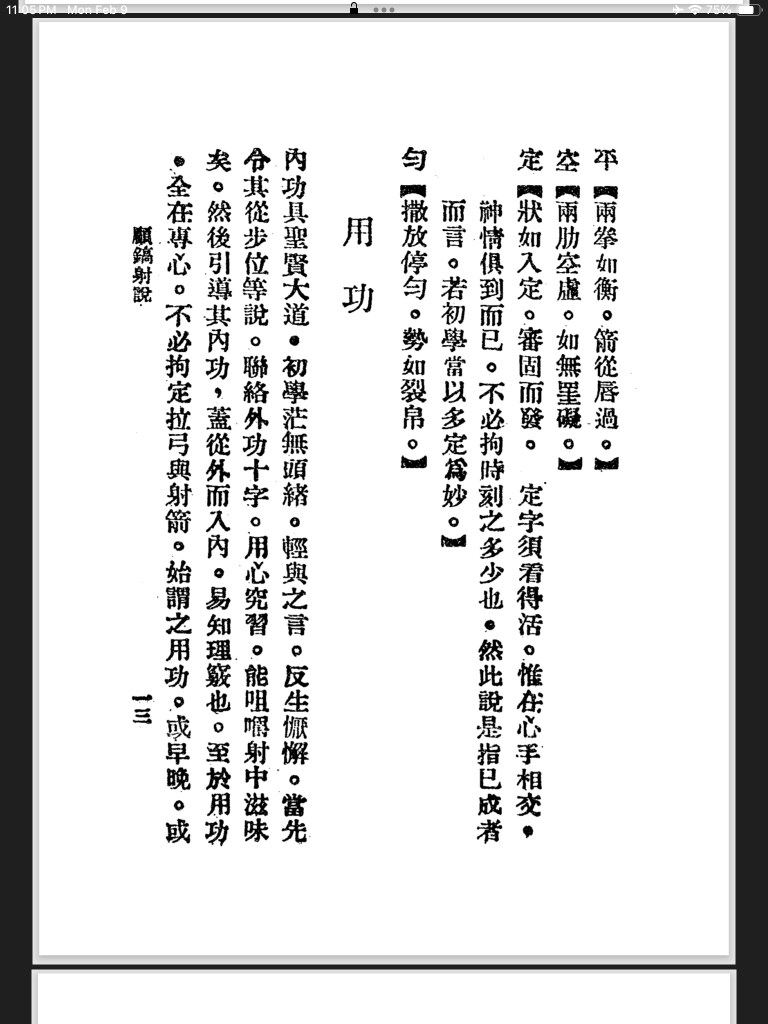
Yong Gong (用功 Applying Efforts)
After introducing the four inner efforts and the ten keywords of outer efforts, Gu introduced Yong Gong a section on how to apply inner and outer efforts; and other sections on stance, grips, nocking, eye power (aiming), to draw, the release, bow strength, bow / arrow matching, bow tuning, and an after word. This post will only partially translate and discuss Yong Gong. Below is a partial translation of the section:
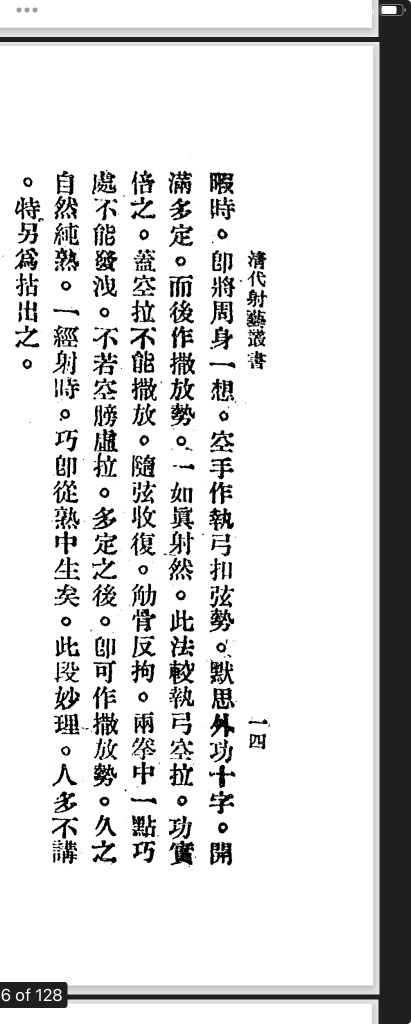
“Nei-gong contains the way of the sages, and it is inconceivable by the beginners. To speak of it lightly to them will only create boredom. Therefore, they should first be introduced to the stance and other basics and associate them with the Ten Keywords of Wai-Gong. Practice and study them with focus and experience them. Their Nei-Gong can then be channeled from Outer (Wai Gong) to Inner (Nei Gong); because the principles can be easily understood as such.
The application of efforts is all about focusing on one’s mind. It does not take drawing and shooting to be considered applying efforts. Whenever one is free day or night, observe the body. With empty hands, pretend to be griping the bow and nocking. Silently contemplate the Ten Keywords of Wai Gong. Achieve full draw and focus (in the state of Ding) extensively and then perform a release as if one were shooting ….
…. This profound principle is not often spoken by others, so I specifically reveal it here.”
This post will be continuously updated with links to related videos and posts as many of its concepts pertains to the ongoing series from Mr. Li Qing Yang’s teaching videos and other Qing’s archery texts.
Here is a video with many draws and releases. Perhaps you can evaluate them against Gu Hao’s descriptions 🙂 I personally like Gino’s draw and release the best. (He is from our Philippines Chapter)
This release reminds me of the description that a release has the force of tearing fabrics!
Your Humble Administrator,
Stephen
Toronto
 International Manchu Archery Association 国际清弓协会 Gurutengge Manju Gabtan i Isanun
Leave a comment