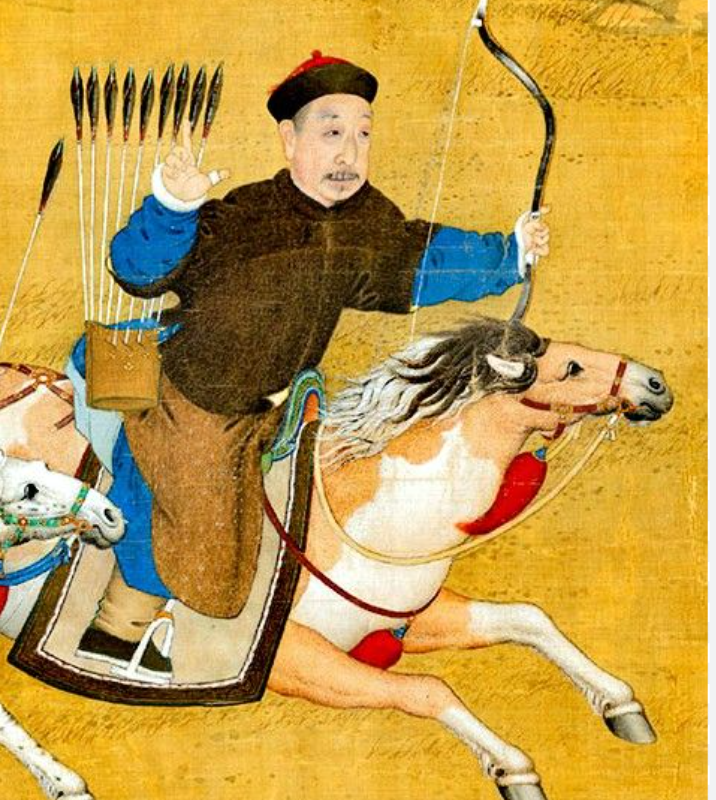
Lesson 2 – The Bow Hand Grip Technique: Diao-Zuan (雕攥)
With a basic understanding and experience with Zhan-Wei in Lesson 1, let’s starts with the bow hand’s grip. The gripping technique introduced here is referred to as Diao-Juan. It will be using various parts of the bow hand staring from:
- The Pinky,
- The Ring and Middle Fingers,
- The Index Finger and Thumb, to
- The Zhang-Xin (掌心, lit: the Palm’s center, the meaty part of the palm).
Mr. Li stressed that a proper grip is the core of all techniques pertaining to using a Manchu bow. All subsequent techniques are expansions to one’s ability to perform a proper bow grip.
Before demonstrating the technique, Mr. Li criticized few common mistakes by some traditional asiatic bow archers and Manchu bow archers today:
- Gripping like a modern recurves with a loose grip using the index finger and thumb.
- Superficially mimicking a Korean style khatra
- Superficially mimicking a Japanese Kyudo khatra
- Swinging the bow after release and thinking it is khatra
Wrong Bow Hand’s Grip
First, the modern recurve grip is a loose grip perform only by the thumb and the index finger. It is wrong! It incompatible with a Manchu bow (or any other Asiatic tradional bows) because modern recurve bows are built with an arrow rest and a build-in arrow window; allowing arrows to leave from the center of the bow. On the contrary, traditional asiatic bows have no arrow rest and arrow window, so it relies on some kind of bow maneuver (popular known as khatra) to create a temporary arrow window upon release.
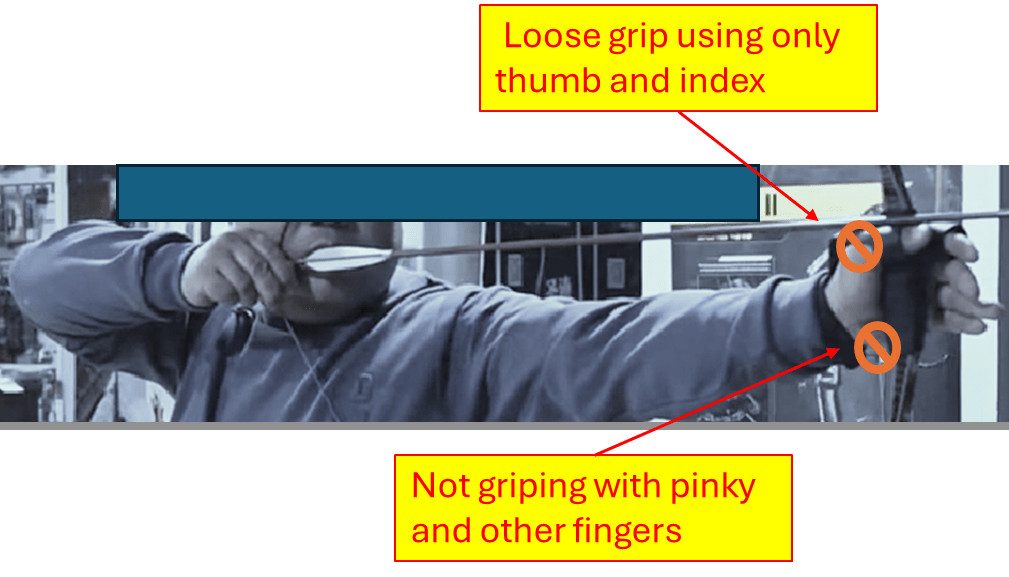
An interesting phenomenon in China in recent years is the popularity of modern recurve grip in “traditional” archery, jokingly known as the Mala-Sonata (马拉桑拿他lit. a horse pulled Hyundai Sonata. A satire to their mixing of modern technique with tradition bows). I cannot testify its effectiveness, but some say this new technique is accurate in tournaments. Let me know if this is common amongst English speaking Asiatic bow archers too.
Wrong Bow Maneuvers
Most traditional and Manchu bow archers are aware of the incompatibility of the “Mala-Sonata” approach with their traditional style bows. They might perform khatra to create the temporary arrow window upon releasing the arrows in ways that might not be most suitable with Qing / Manch bow. Some new archers may even swing the bow wildly thinking that they are performing a khatra. The result is a wide horizontal spread in arrow grouping.
Here are more examples of the common mistakes identified earlier:
A mimicked-Korean Khatra
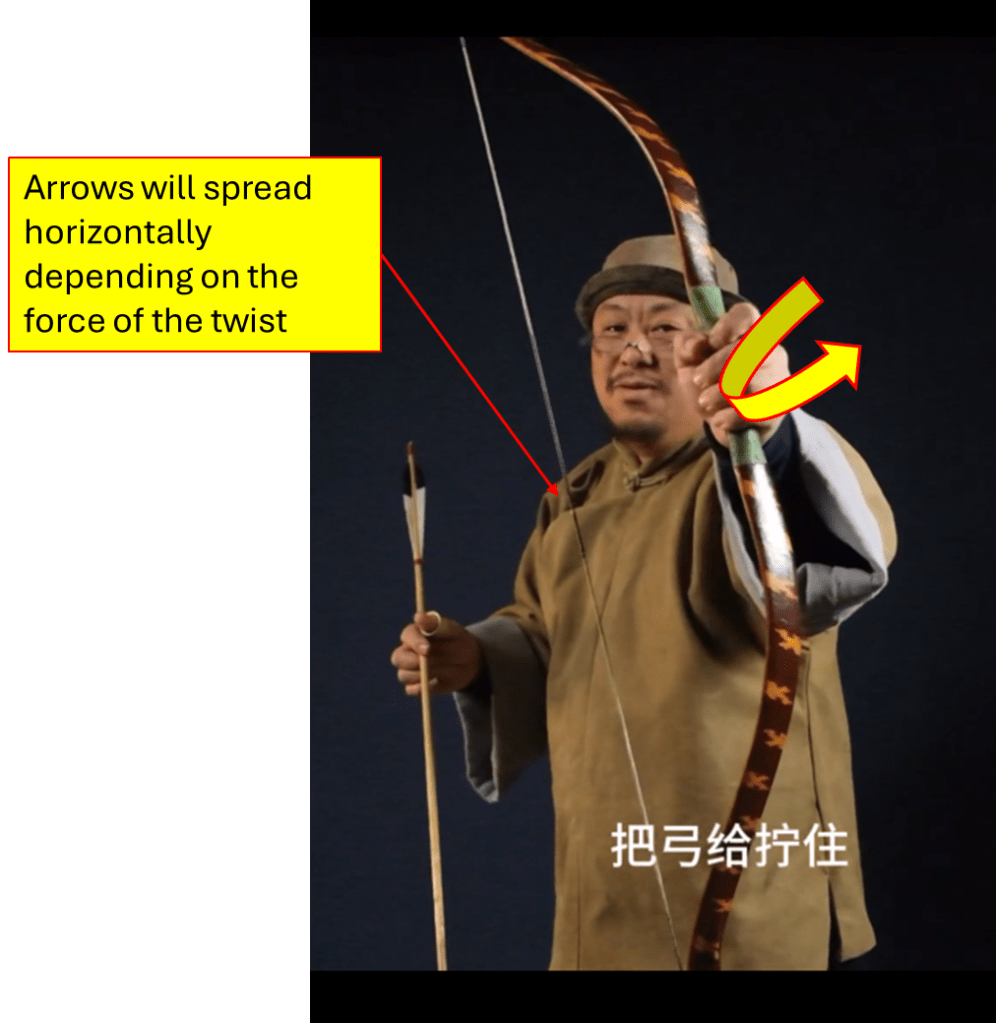
Mr. Li referred to the mimicked-Korean khatra as a Pian-Tui (lit. side push). Unless one’s side push is consistent and precise, every shot would be different and result in a wide horizontal spread.
A mimicked Japanese Khatra
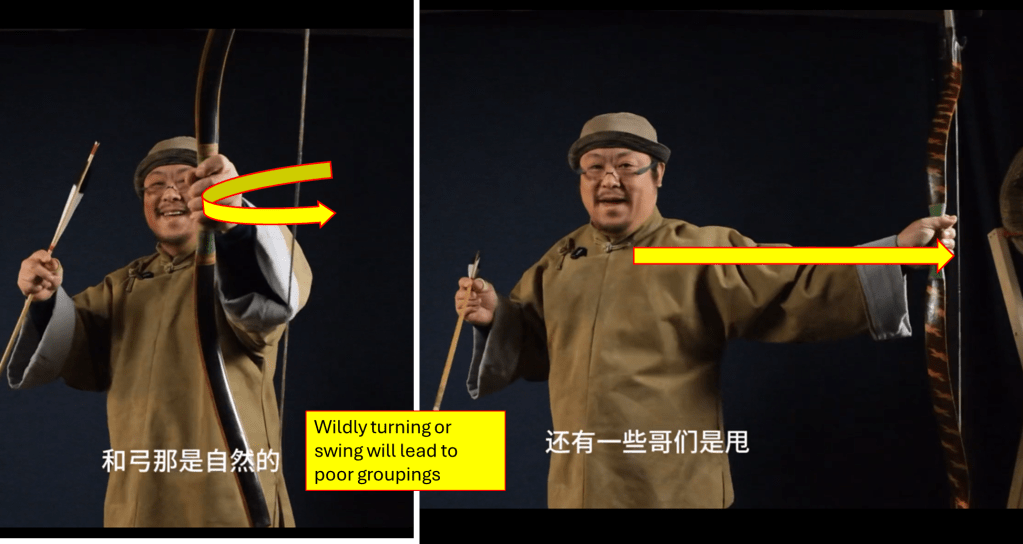
The mimicked-Japanese khatra is often intentional and forced when using the Manchu bow by those without kyudo trainings. The forced khatra are often just a wild swing.
Please note that this is not a criticism of other country’s techniques but simply pointing out that some “traditional archers” in China are haphazardly mimicking Korean and Japanese techniques and applying them poorly when shooting the Manchu bow.
Introducing the Concept of Diao-Zuan
A good release and creating the temporary arrow window is built around a good bow hand grip. The essence of a good grip is pushing the bow handle with one’s Zhang-Xin, which is often known as the meaty part on one’s palm. Mr. Li, however, suggested that “Zhang-Xin” is not a findable body part and created by one’s proper gripping of the bow.
Here is a step-by-step exercise to practice good bow hand grip for beginners to feel it:
Step 1: Press down the bow and at this moment of tension grip the bow with all fingers and lift up.
Step 2: The fingers all work together from the beginning of the grip in Step 1 and never let loose throughout the cycle of drawing and shooting the arrow:
- The pinky is coiled around the grip and apply the most strength
- The ring finger apply less strength
- The middle finger is loose
- The index finger is Xu (lit: empty, blank, being there but not there)
- The Thumb points forward along the bow grip.
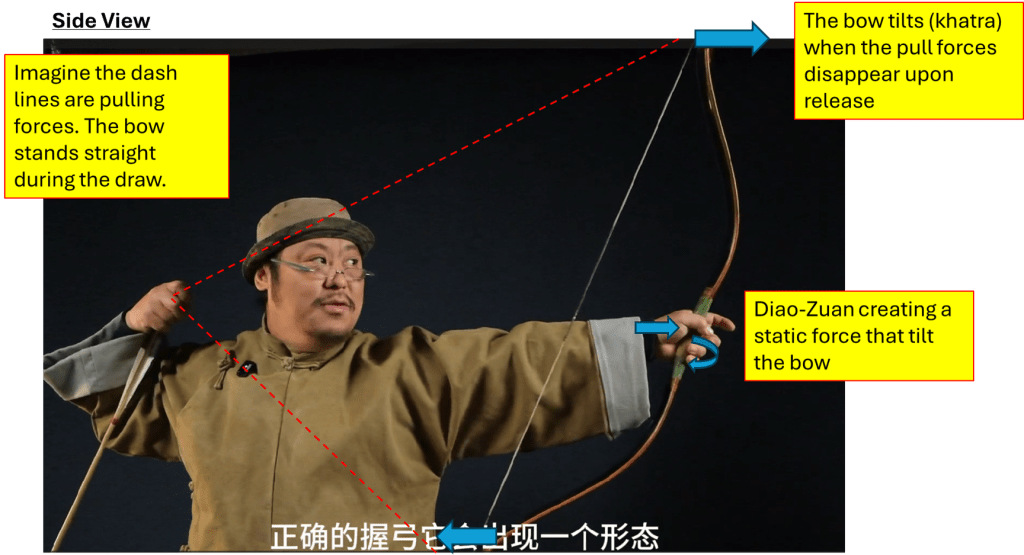
Step 3: The grip creates a static force that tilts the top Siyah forward.
Step 4: For Beginner to check:
- Keep the grip firm and fully extend and check there are couple inches of gap between the string and one’s sleeve.
- Draw the bow and feel that the tilt being an An-Jing (暗劲 lit. hidden force. In physics we can think of it as a static force being applied to an object)
- (Optional with nocked arrow) release the string and shoot the arrow. Manchu bow will tilt forward slightly and then balance itself.
This is Diao-Zuan, and it consist of two parts:
- Diao (lit. Eagle) It is a motion referring to the pink, ring, and middle fingers coiling and hooking around the bow grip; drawing it backward. Like an eagle claw.
- Zuan (a pushing motion) referring to the thumb pointing forward while holding the bow grip. The center of palm (which pushes) is clearly the Zhang-xin.
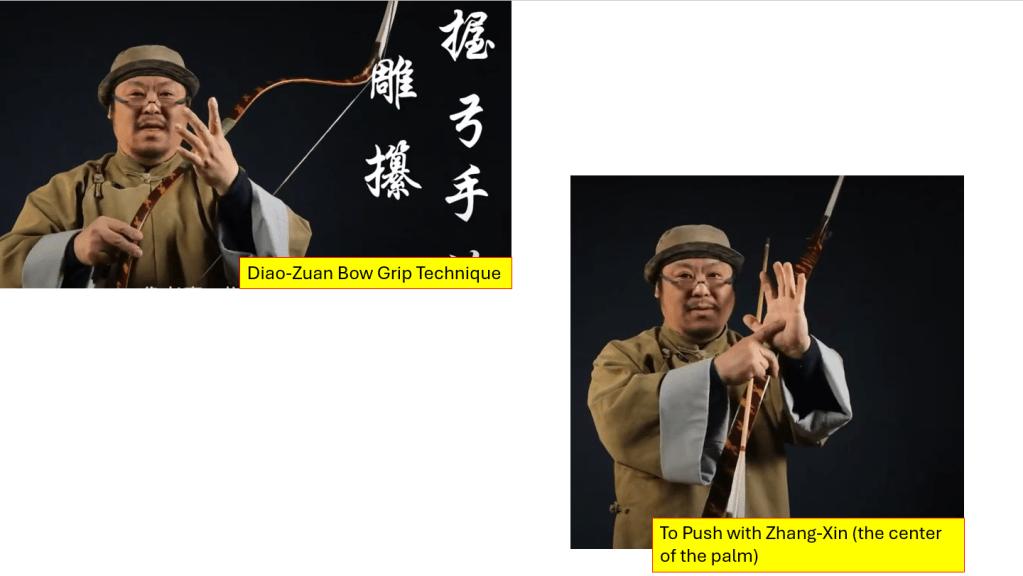
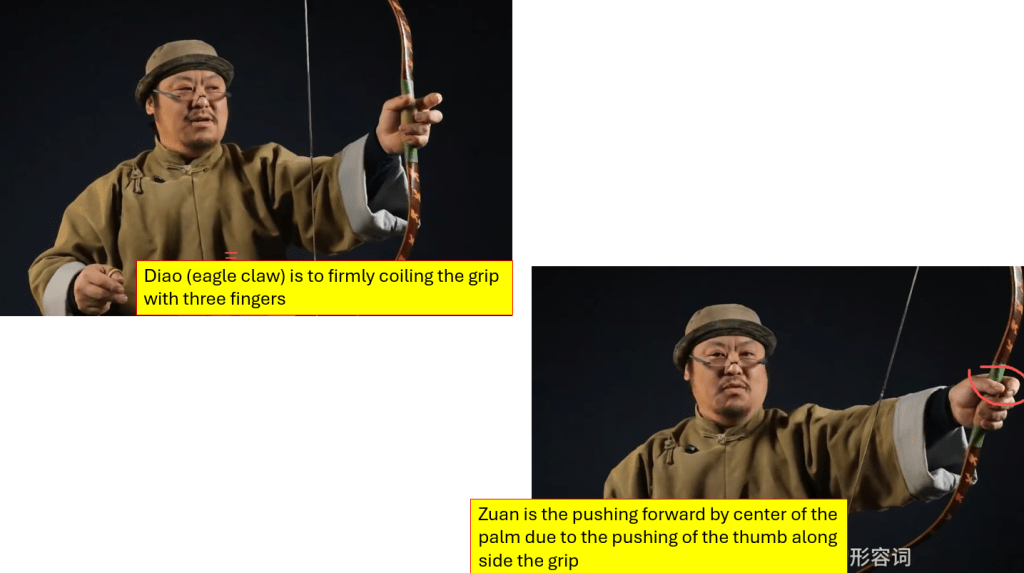
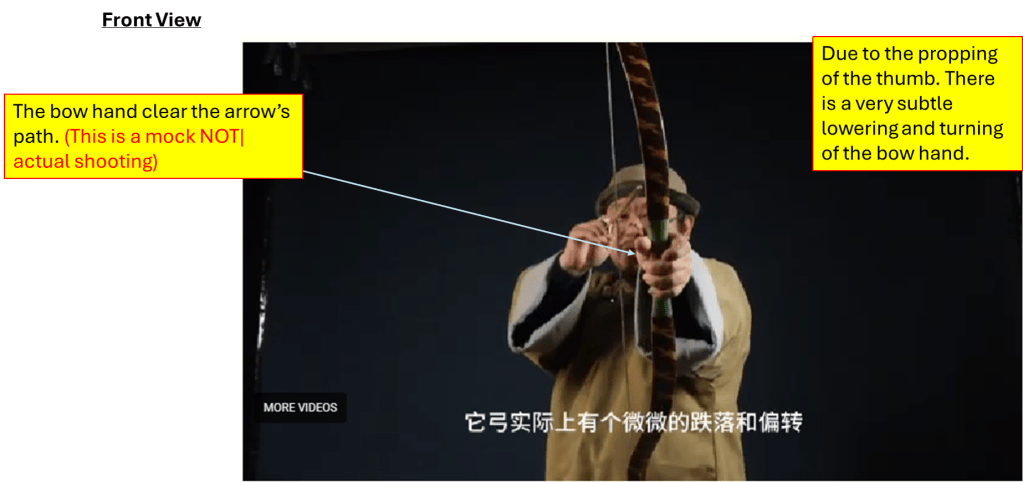
When this grip is applied when drawing the bow and then releasing the string, we can observe the creation of a temporary arrow window by two resulting phenomenon: Dian-Shao (点弰,the tilting of the top shiyah) and the front hand dropping away from the flying arrow.
This very subtle window is equivalent to a “QIng style khatra”, allowing the arrow to pass, and without the risk of a wide horizontally spread grouping. This “khatra” (for the lack of a better word) minimizes interference between the bow and the arrow shaft. We should listen to our release. If there is a percussive noise between the arrow and the bow, one’s should refine his or her Diao-Zuan to reduce interferences.
Summary
Traditional archers use “Khatra” to create a window to the arrows to clear the bow and the archer’s bow hand . This minimizes interferences to the arrow’s flight. A Qing style Khatra is unintentional. It is created by solely the static force coming from the Diao-Zuan grip. When the string is released, the bow will tilt forward and one’s bow hand subtly clear the arrow. Refer to the Step-by-Step guide for the Diao-Zuan Grip.
Below is an example of Emperor Qianlong performing a Qing style khatra:
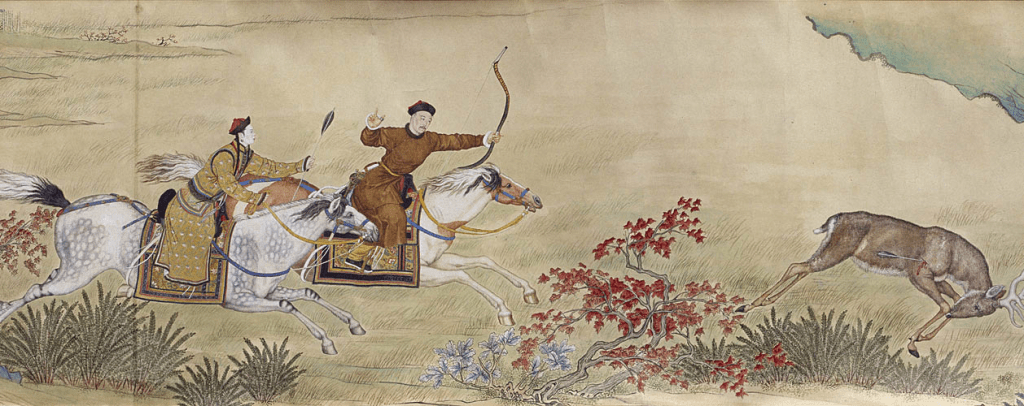
The artist brilliantly captured the subtle tilting of the Emperor’s khatra.
Below is a BAD EXAMPLE of Diao Zuan. Note how the fingers are stiff and the thumb fails to prop against the grip.
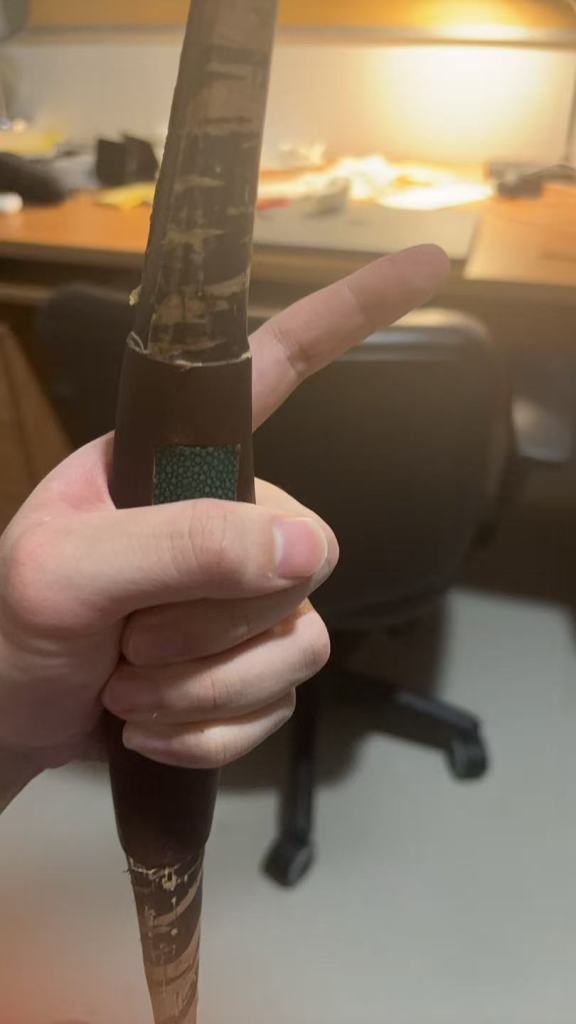
 International Manchu Archery Association 国际清弓协会 Gurutengge Manju Gabtan i Isanun
Leave a comment