Kou Jian 扣箭 – Nocking the Arrow (with Thumb Ring Technique, and Structural Alignments)
In this section called Kou Jian (扣箭 lit. Nocking the Arrow), Gu Hao first speaks of arrow nocking and how to properly using the Manchu cylindrical thumb ring. He also inserts an interesting commentary on a very important concept on archery structural alignments known as San-Kao (三靠 lit. the Three Rests), and how they are facilitated using proper movements of the bow and draw hands. Then, he resumes the subject on thumb ring techniques; describing the qualities and the importance of subtlety when it comes to hooking the bow string.
The translated text is split into three sections below. Translated texts are quoted and italicized.
Section 1: on Nocking and Using the Thumb Ring
“When nocking the arrow, it is a mistake to look at the bow string. The action should be quick and traceless ( (i.e., a quick and clean action).
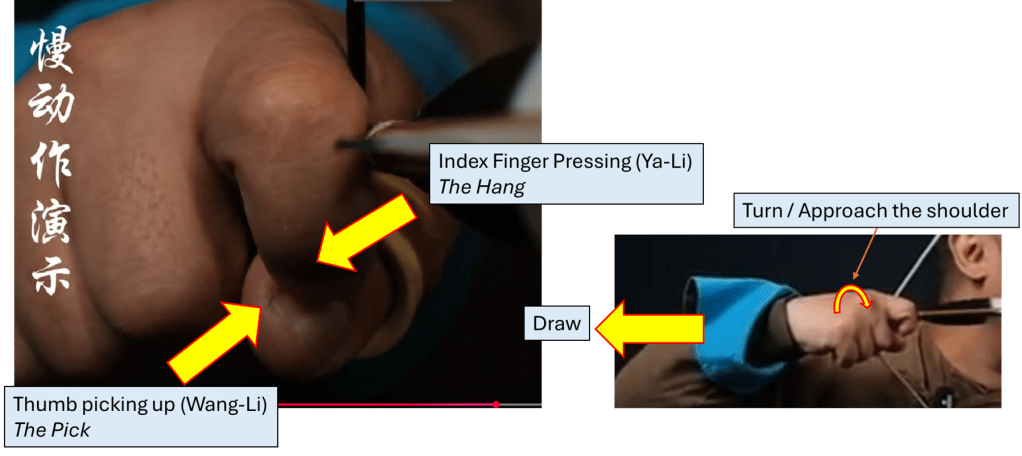
After nocking the arrow to the bow string, your thumb and index finger should be tight against each other. The tip of the index finger is not beyond the thumb’s nail (i.e., the tip of the index is on the thumb nail). The thumb applies Wang-Li (a rising force) and the index applies Ya-Li (压力 a pressing force). The other three fingers are neither Xu or Shi (虚实 lit. empty or solid).”
Although this article is titled Nocking the Arrow, Gu merely discussed it in one line. He seems to advocate blind nocking using quick and minimal movements. The rest of the paragraph talks about a thumb ring technique known as Tiao-Gua (挑挂 lit. to pick and hang), which is in fact the main subject of discussion.
The very same technique was also documented in the renowned Qing Military Illustration and promoted by Mr. Li Qing Yang. See illustrations from the Qing’s Illustrated Military Manual below:
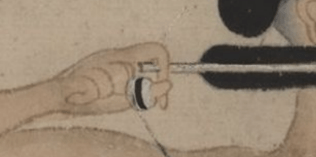
I consider this somewhat an advance technique because (from personal experience) because it is harder to perform comparing to the more popular Dan-Gou (单勾 lit. Single hook) used by most Western Manchu bow archers today. The Dan-Gou is easier to learn, but it could be prone to the poor practice of over hooking (i.e., a deep hook).
However, the idea of using Wang-Li and Ya-Li by the thumb and index finger is applicable to both Tiao-Gua and Dan-Gua techniques. As the name Tiao-Gua suggests the rising force (Wang-Li) is created by the thumb picking upward and the pressing force (Ya-Li) is created by the index finger hanging on the nail of the thumb. (See figure below)
Section 2: on the Bow/Draw Hands and the Concept of the San-Kao (Three Rests) body structure
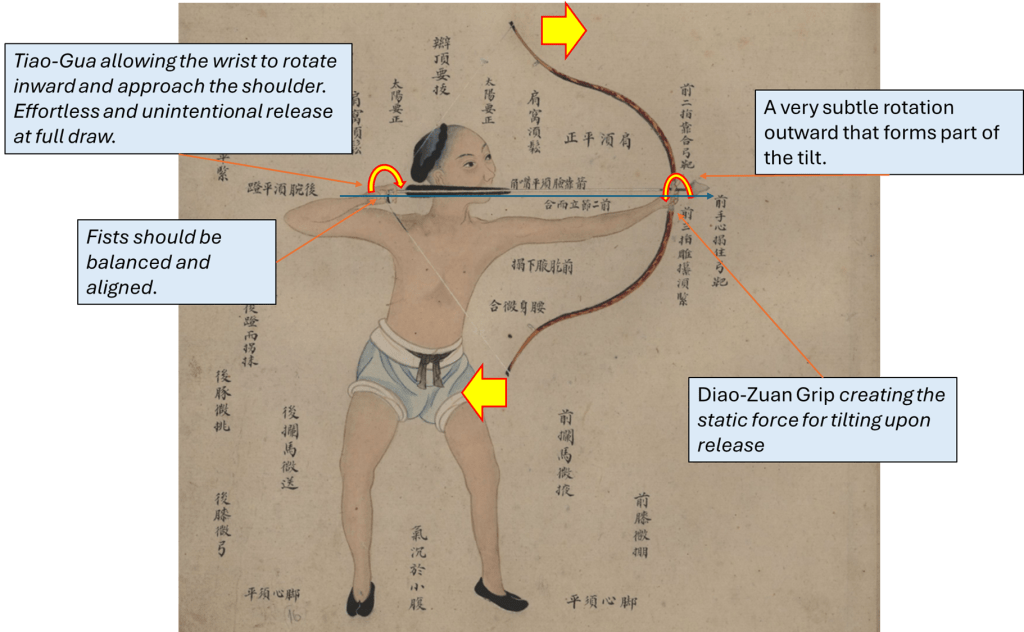
“The front fist (i.e., the bow’s hand) should tilt outward and the back fist (i.e., the draw hand) should roll inward. With proper bodily structure, the front fist tilting, and the back fist rolling; it will be natural for your wrist to “rest on” the shoulder, your ribs to “rest on” the bow string, and the arrow to “rest on” your face. Also, the thumb and index of the front fist must very subtly stabilize the arrow shaft from both sides.”
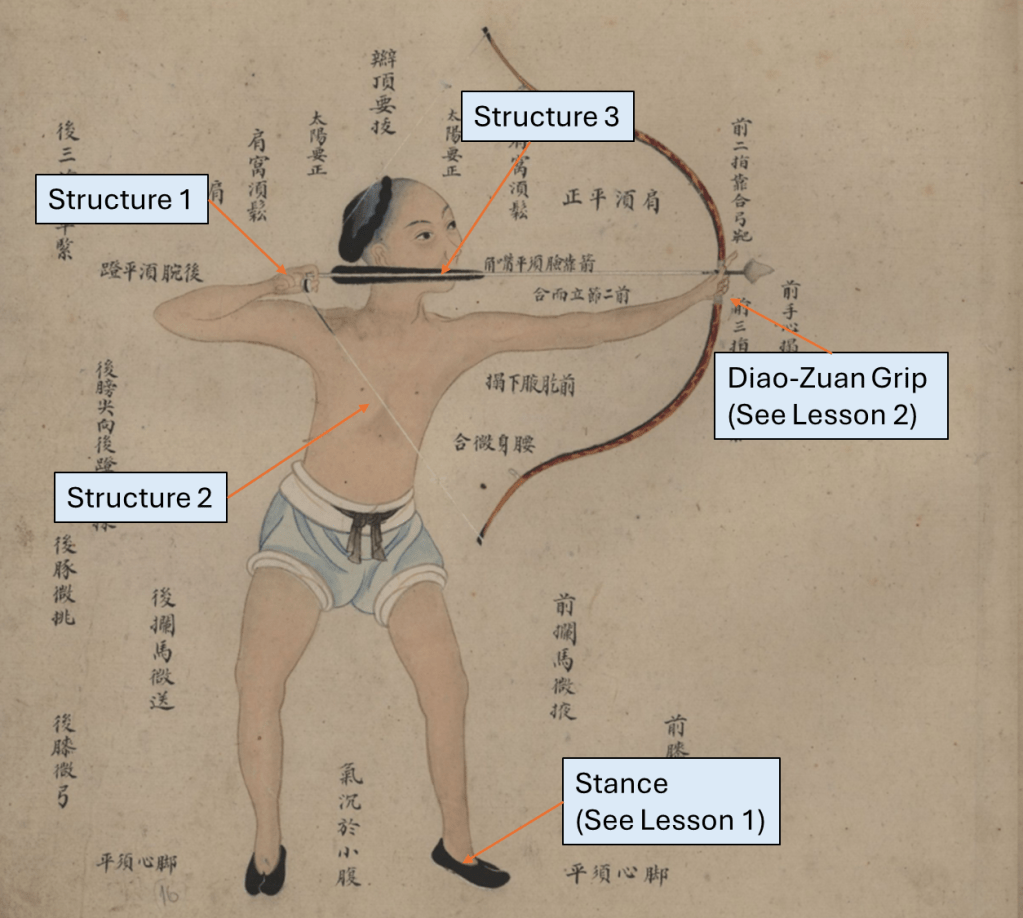
The idea of San-Kao is of paramount importance in Qing Archery because of its long draw, and it could be applicable to all Asiatic archery styles. San-Kao is asking the archer to perform three kinds of structural alignments:
Structure 1: Aligning the wrist on the same vertical plane of shoulder
Structure 2: Aligning the rib cage toward touching the string with the symbolic “Manchu archery lean” and turning one’s body sufficiently during the draw
Structure 3: Align the arrow to the face by “pulling” the arrow and the bow toward your body and settling the arrow to the corner of the lips.
Unlike western archery, Manchu archery (and majority of Asiatic archery styles) has no obvious anchor points. Yet the alignments in San-Kao provide some sort of repeatable body structure so that shots can be made in a consistent manner. Again, I will refer to the Qing Military Illustration as an example of San-Kao application.
According to Gu, these alignments come naturally with the ability to tilting the bow hand outward and rolling the draw hand inward, i.e., Wai-Wo-Nei-Gun (外卧内滚 lit. Outward tilt and Inward Roll).
Section 3: Further comments on Using the Thumb Ring
“Lastly, regarding the topic of Jue Shi (决拾it. Thumb ring and sleeve guard. Here it refers to the technique of using the cylindrical Manchu thumb ring). It should be shallow, and a Ban-Kou (半扣 lit. Half nock, but I believe nock here refers to the thumb hook) is of the highest skills. It facilitates a good release, and the arrows will go with good speed and distance.”
In this section, Gu is returning to the Tiao-Gua techniques and describing its qualities. He kept describing it being a shallow hook without giving out further details. All I can make out of his words is that the hook should be as shallow as one is capable of to the point that the ring is merely “semi-hooking” the string.
For modern Manchu bow archers, I think Mr. Li Qingyang’s description can answer many of my questions regarding to Tiao-Gua. He advocates the Tiao-Gua thumb ring technique because it is as shallow as one can get using the cylindrical ring for hooking the bow string. During the draw because of the design of the ring and applications of forces by the thumb and the index finger, the arrow is tucked in place and there is no chance for the string to slip. Then one properly draws the bow to its fullest with proper alignments, the ring will slip out with (almost) no efforts nor intention from the side of the archers. See videos of his demonstration below:
A future post will be created in reviewing the above demonstration by Mr. Li.
Gu Hao’s Final Notes on Nocking (and the other subjects)
Lastly, Gu ended this section of his commentary with a riddle.
“You must not be ignorant to the marvelous use of Xu-Shi (虚实 lit. Empty and Firm)”
It is often difficult to comment on this kind of old Chinese expressions because they are almost Zen like. For a simpleton like me, I see this as the taste of fine tea can only be experienced by one’s tongue and cannot be shared, so let’s pick up the bow and shoot.
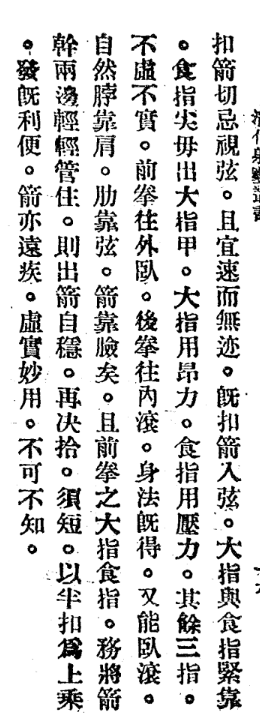
Original text:
 International Manchu Archery Association 国际清弓协会 Gurutengge Manju Gabtan i Isanun
Leave a comment