Manchu / Qing Archery Techniques – Lesson 1: Zhan-Wei (the Stance)
Everything good starts with a strong foundation, be it the Ancient Egyptian Pyramid or the Kamakura Buddha of Japan, and it’s the same for Manchu Archery. Therefore, this series of posts on Qing / Manchu archery techniques will begin with Zhan-Wei (站位, the Stance) for the purpose of achieving:
- proper Shen-Di (审的 ,evaluating the target or aiming in the sense of modern archery), and
- achieving upper body mobility for the purpose of shooting quickly at various angles.
Please note that this technical series is based on my notes while studying Mr. Li Qing Yang’s videos with the videos also being provided here for your reference. Any flaws in translation and interpretation are mine alone.
Zhan-Wei is consisted of three elements:
- the Feet,
- the Legs, and
- the Wasit / Upper Body.
The Feet
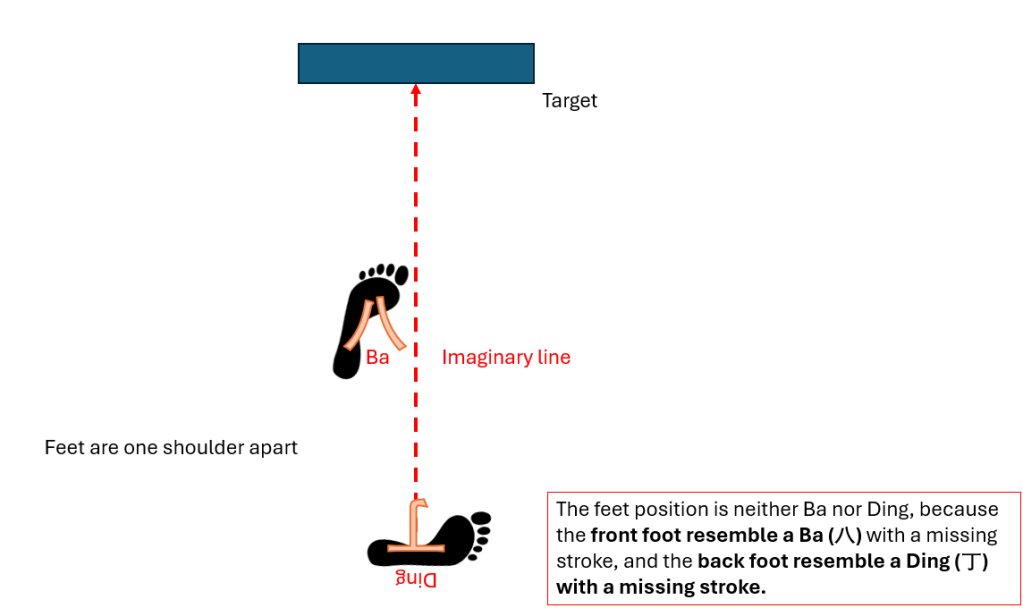
Zhan-Wei (the Stance) starts together with Shen-Di. Shen means evaluation, and Di means target. One’s back foot steps into proper alignment with the target by evaluating one’s spatial relationship with the target and the environment. Imagine there is a line perpendicular to the centre of the back foot and pointing straight at the target. Beginner may place a stick or an arrow for the line. The toe of the front foot should touch the imaginary line. The feet should be one shoulder length apart and oriented in a position called Bu-Ding-Bu-Ba (不丁不八, lit. “Not Ding Not Ba” or Being neither Ding nor Ba).
The Ding (丁) character refers to the back foot being perpendicular to the imaginary line and parallel to the target surface, and the Ba (八) character refers to front foot pointing slightly inward. Because the front foot is pointing inward, the feet do not form a Ding character. The back foot is pointing directly outward forming a straight line perpendicular to the imaginary line, so neither a Ba character is formed. An illustration is provided below.
The Legs
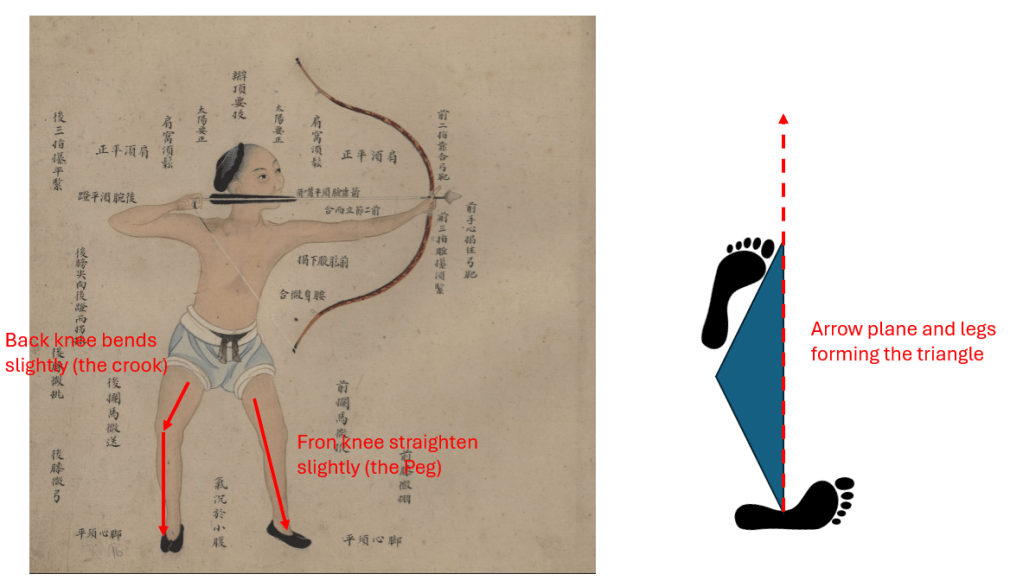
Correct weight distribution of the stance is not equally placed in the center. Bu-Ding-Bu-Ba allows one’s weight to be properly placed in a center-right position with slightly more weight supported by the back leg. On the basis of the feet being Bu-Ding-Bu-Ba, the legs should follow a posture calls Qian-Jue-Hou-Que ( 前橛后瘸,pegging the front leg and crocking the back leg). The leg muscles should be firm with the anus tightened, forming a strong base (where the arrow plane and the legs form a triangular base looking from above the head) that support the upper body movements. This allows upper body mobility to shoot 180 degree and up and down in front of oneself with the waist acting as a bearing and the legs being supports. However, keep in mind that being firm is not stiffness, and one should be relaxed and only becoming firm when rising the bow.
The Waist and Upper Body
During the early stage of the draw and after creating a firm base with the feet and the legs, the waist and upper body should first be relaxed and only to be firmed during the draw. They are firmed by the manipulation of one’s Qi (气,air, wind, ki, or energy) through a breathing cycle in combination with Zhan-Wei:
- Properly place one’s feet and set up Bu-Ding-Bu-Ba
- Gently breath out when nocking the arrow
- Breath in while lifting the bow and firming the legs in Qian-Jue-Hou-Que
- Gently breathe out around half of the air firming the chest and belly
- One should feel the Qi acting like an air cushion in the torso.
- Chinese refers to this as Qi-Ju-Dantian (气聚丹田Qi settling into the Dantian, lower belly)
- This is done with the draw
- The whole body should be firm before release
- Release and breath out completely
- Resume normal breathing
- Repeat from step 2.
About Mr. Li, Qing Yang
Mr. Li is a horn bow maker and senior Qing archery practitioner based in Chong Qing, China. He is most generous in allowing our association to use his videos and offered to answer any questions from Manchu bow archers. Please feel free to post your question in the comment section.
You may also reach out to the Canadian Chapter if you have any questions regarding to the contents above.

 International Manchu Archery Association 国际清弓协会 Gurutengge Manju Gabtan i Isanun
Leave a reply to Oscar S Cancel reply